



For many Kenyan couples, the journey to parenthood doesn’t always follow the expected timeline. Sometimes the road bends, pauses, or takes a detour. And in those moments, in-vitro fertilisation (IVF) has become one of the most hopeful paths, one that more families in Kenya are starting to explore with courage and curiosity.
If you’re struggling to get pregnant and considering alternative and assisted reproduction, we discuss below how IVF in Kenya works, average costs, success rates, and what you can expect throughout the process.
How is Invitro Fertilization (IVF) Done?
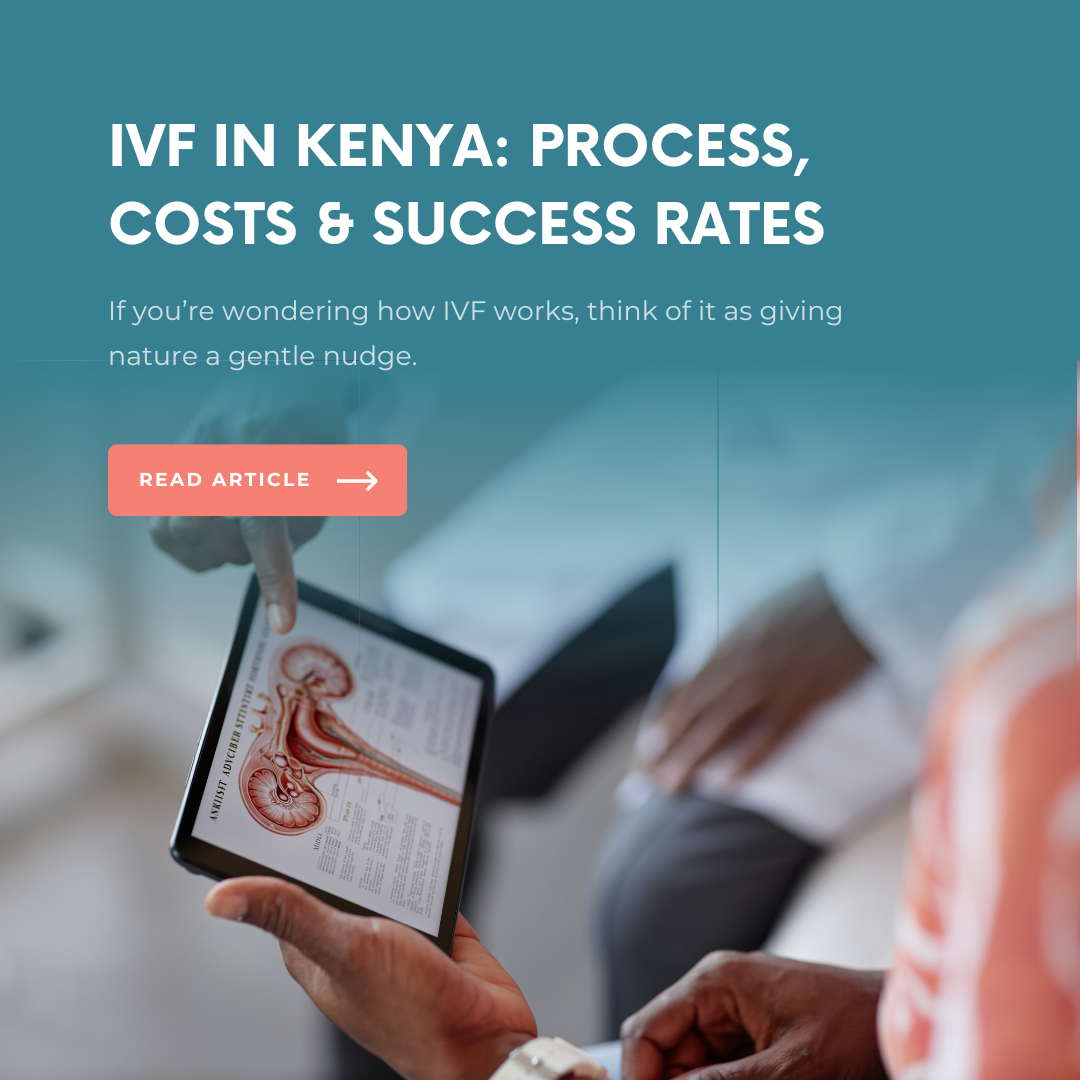
If you’re wondering how IVF works, think of it as giving nature a gentle nudge. Instead of waiting for the sperm and egg to meet inside the body, doctors help them meet in a controlled, safe environment like a very high-tech “first date.”
The step-by-step IVF treatment process in Kenya looks like:
- Ovarian stimulation: After the initial consultations to learn your health history, your fertility doctor begins the IVF process with hormonal medications and injections that encourage the ovaries to produce more eggs than usual.
- Egg and sperm retrieval: After a few weeks of monitoring through ultrasounds and blood tests, the eggs are retrieved through a short surgical procedure. Your partner will also provide a sperm sample on the same day.
- Laboratory fertilization: An IVF specialist and embryologist then combines the egg and sperm in a laboratory for fertilization. After fertilization, the embryo is transferred into an incubator for further development.
- Embryo transfer: Finally, the doctor places the embryo into the uterus through a thin cervix catheter to grow just like in a natural pregnancy. That’s it! After 2 weeks or so, you’ll return to the clinic for a blood pregnancy test to confirm if the IVF was successful.
The Cost of IVF in Kenya
In Kenya, IVF isn’t a mystery reserved for the elite anymore. Fertility experts and clinics have grown in number, and couples now have options in Nairobi, Mombasa, Kisumu, Nakuru, and Eldoret.
The cost, however, can still feel like investing in a small plot of land. On average, a single IVF cycle ranges from around KSh 350,000 to KSh 600,000, depending on the clinic, medications, tests, and any additional procedures needed.
For example, the cost of normal IVF at the Harley Street Fertility Centre in Muthaiga is KES. 650,000 – 700,000 and KES 665,000 – 760,000 with a donor. The same treatment goes for KES 600,000 at Nairobi IVF Centre with an additional KES 30,000 if you need a sperm donor.
Some clinics also offer payment plans, while others allow couples to pay in stages. It’s the kind of bill that makes you briefly question your life choices but still feels worth every shilling when you imagine the outcome.
IVF Success Rates in Kenya
One of the big questions couples ask is whether IVF actually works. The honest answer is: it depends. Factors like age, underlying fertility issues, and overall health play a huge role. Women under 35 generally have higher success rates, sometimes close to 40–50% per cycle, while for women over 40 the rate can drop significantly.
According to Dr Kireki Omanwa, a renowned fertility expert and President of the Kenya Obstetrical and Gynaecological Society (KOGS), “The success rate varies and depends on many things. It depends on the age of the patient, especially the lady. The success rate starts dropping after 35 years.”
The quality of the sperm matters too and poor sperm quality leads to implantation failure or a miscarriage.
But success isn’t just a number; clinics across Kenya have seen countless stories of hope, resilience, and happy endings. Some couples conceive on the first try, others need two or three cycles, and some choose alternative fertility options like Intracytoplasmic Sperm Injection (ICSI), donor services, or surrogacy.
IVF Treatments and Couples’ Mental Well being
The emotional part of IVF is something people don’t talk about enough. The excitement, fear, hope, hormones, tears, laughter, are a roller coaster. Many Kenyan mums describe the experience as one of the most vulnerable yet empowering seasons of their lives.
A study shows that couples going through IVF treatments experience anxiety, depression and low quality of life but women are more likely to have higher levels of psychological distress than their partners.
And the support systems around them, from spouses, fertility counsellors, support groups, and even WhatsApp circles, make a huge difference. This journey is not just medical; it’s mental and emotional too.
Final Thoughts
If you’re considering IVF in Kenya , take your time to do research, talk to specialists, and understand your options fully. Ask all the questions, even the awkward ones. And remember, you’re not alone. Thousands of Kenyan families have taken this road before you and many are walking it right now.
IVF may not be the easiest journey, and yes, it can test your patience, budget, and emotions. But for many couples, that first cry in the delivery room makes every injection, every clinic visit, and every prayer worth it. If this is the path you’re taking, walk it with hope. Miracles happen here every day.
For expert preconception care to prepare your body for pregnancy, the team at Malaica offers comprehensive assessment and advice on your fertility options. And when you go through the treatment and get the double lines, Malaica offers personalized antenatal care from when you conceive until post natal, including psychological support, online community of mums, and 24/7 access to a nurse midwife for when you need a professional opinion.